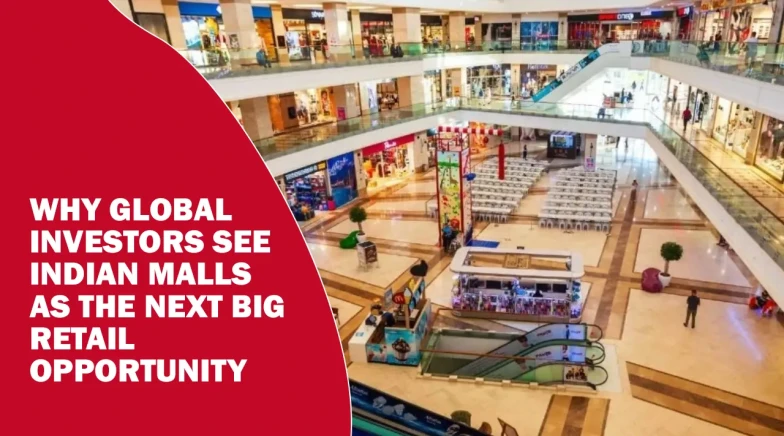
Why Global Investors See Indian Malls as the Next Big Retail Opportunity

- Created Jan 02 2026
- / 53 Read
Why Global Investors See Indian Malls as the Next Big Retail Opportunity

Why Global Investors See Indian Malls as the Next Big Retail Opportunity
-by Jaya Pathak
Over the past five years, the global retail markets have undergone a massive change. Malls have been shut down. Department stores that were anchors—gone. Investors who put money into Western retail? They've basically been waiting years just to break even. It's a mess over there honestly.
But then look at what's happening in India. Completely different story. Investors are moving serious money into Indian malls right now. We're talking about $3.5 billion flowing in over the next three years. That's not small change. And it's not because of hype or temporary trends. There's actual structural stuff happening that makes Indian retail real estate different from what's going on in the West.
The Real Problem
The real problem with India is that the country doesn’t have enough retail spaces. In big cities, this space is around 0.6 square feet of a quality mall space per person. But if you will compare it to that of America, it is around 23 square feet per person. In China, it is about 6 square feet per person.
Smaller cities are even worse. Only two to three square feet per person. In most Western markets, 5 percent vacancy is considered normal. Mumbai? Some premium malls are basically 95-100 percent full with waiting lists of retailers wanting space.
Think about that from an investor's perspective. In Western markets, you've got too much space, not enough people wanting it, so landlords are desperate and tenants have all the leverage. In India, it's the opposite.
Young Population Spending More Money
India has a young population of about 65%. That's not just a demographic stat—it actually matters for consumption patterns. This younger generation spends differently than previous generations at the same income level.
The consumption growth projections back this up. India’s retail market will hit $1.3 trillion by 2025 and it will expand towards $6 trillion consumption economy by 2030. The growth rate is way higher than anything happening in Western developed markets.
But here's what's actually different about Indian malls compared to Western ones. In the West, people go to malls to buy things. But in India, Majority of the population doesn’t go to mall for shopping rather it is for food or entertainment purpose. in metro cities, malls become a social gathering spots where families and friends spend their entire afternoons.
This actually matters a lot for the investment case. When malls are primarily merchandise distribution centres, e-commerce wrecks them. But when malls are social destinations where people go to experience things? E-commerce doesn't hurt as much. And in India, e-commerce is only about 8 percent of retail—versus 20-30 percent in developed markets. Physical retail still dominates.
The Actual Numbers Retailers Are Hungry
Fashion is grabbing 21.4 percent of the leasing activity, food and beverage is at 19.3 percent, entertainment is 15.8 percent. These aren't weak categories. These are strong consumer demand areas.
What really surprised me though was that 82.5 percent of the space leasing came from Indian retailers—domestic brands expanding aggressively. Not international chains contracting or consolidating. Indian companies are opening new locations.
For landlords and investors, this creates this almost perfect scenario where you've got consistent, growing demand from multiple retailer categories. Rents are going up. Occupancy stays high. Grade-A mall assets in India are actually generating returns around 14-18 percent internally. Compare that to Western markets where returns are basically half that or less. That's why money is flowing here.
Secondary Cities Are Actually Where Growth Is
These cities currently only have 30 percent of quality institutional retail assets but they're generating real consumption. Young people in these cities have money now. They've seen what malls look like in metros through social media. They want that experience locally. It's a gap that needs filling.
There's supposed to be over 25 million square feet of new retail space added in tier 2 and 3 cities by 2029. Northern India is leading with 44 percent of that supply—cities like Jaipur, Lucknow, Ludhiana getting major projects. South India is 30 percent—Coimbatore, places in Kerala getting development.
What's interesting is that developers aren't just building pure retail anymore. They're mixing retail with offices, hotels, entertainment into these big mixed-use complexes. This spreads the risk. You're not betting everything on retail performance. You've got multiple revenue streams.
And honestly, the economics of building in secondary cities is way better. Real estate is cheaper. Labor is cheaper. You need less infrastructure. Projects become profitable faster—sometimes 18-24 months versus way longer in metros. That attracts developers and investors who want quicker capital recovery.
Why This Matters to Global Investors
The basic situation is this: Western retail real estate has basically become a value trap. Too much space. Declining foot traffic. E-commerce taking share. Returns are weak. Investors are stuck.
India presents the opposite conditions. Structural shortage of space. Growing consumption. Low e-commerce penetration. Strong demographic tailwinds. Returns that are 2-3x what you get in the West. That's why money is moving.
But—and these matters—not all Indian malls are the same. Quality matters. A poorly constructed mall in a secondary city is going to have problems. But a well-built, professionally managed mall with good retailers? Those are attracting capital.
The institutional infrastructure has also matured. Major real estate investment trusts and platforms are now managing retail portfolios professionally. That's given global investors more comfort because there are established management standards and institutional governance.
The risk side needs acknowledgment too. E-commerce will keep growing. Eventually it might hit 15-20 percent penetration. That'll impact physical retail. Also, policy could change. Foreign investment rules could shift. These are real uncertainties.
But the structural thesis—undersupply, demographic growth, consumption expansion, low e-commerce penetration—that seems solid for the next 5-7 years at minimum.
Frequently Asked Questions
1: Is India's retail supply shortage real or temporary?
The shortage is structural. At 0.6 square feet of quality mall space per capita versus 23 in the US, India has roughly 40 times less retail infrastructure. Grade-A mall vacancy sits at 2.27 percent with documented waiting lists for retail space. This undersupply will persist for several years as new supply takes time to build. Landlords have pricing power.
2: Where is the real growth happening for investors?
The real growth is happening for investors in Tier 2 and tier 3 cities which is generating 60% of India’s retail growth.
3: What returns can investors actually expect from Indian mall assets?
Investors can expect around 14 to 18% rates of return.
Explore: Moderntimes24.com
For Add Product Review,You Need To Login First